
10-27 September – Lundy Campsite
It’s Summer 2024, and I (Kieran D.) have just returned from my first trip with the club in Pembroke. I’ve decided that it will be useful to buy my own static rope so that I’m fully equipped to lead routes next time. So, I consult the UKC forums about what size I’ll need, and it seems 50-60m will be sufficient. Unless of course I plan on climbing in Lundy, in which case I’ll need 100m. Inception. I don’t realise it yet, but my subconscious has already decided I’m going to Lundy.
Over the course of the next few months, the idea takes greater shape in my mind, and I start dropping Lundy into conversations with other climbers. Then one evening at Hub late in 2024 Peter mentions he’s planning a Pembroke trip in April to attend the Range West briefing. I’m keen on that, and I mention my desire to go to Lundy. He’s keen, reckons Neal will be too, and a date is ultimately set for September 2025. The campsite is booked, James joins the group, and we patiently await the start of the trip.
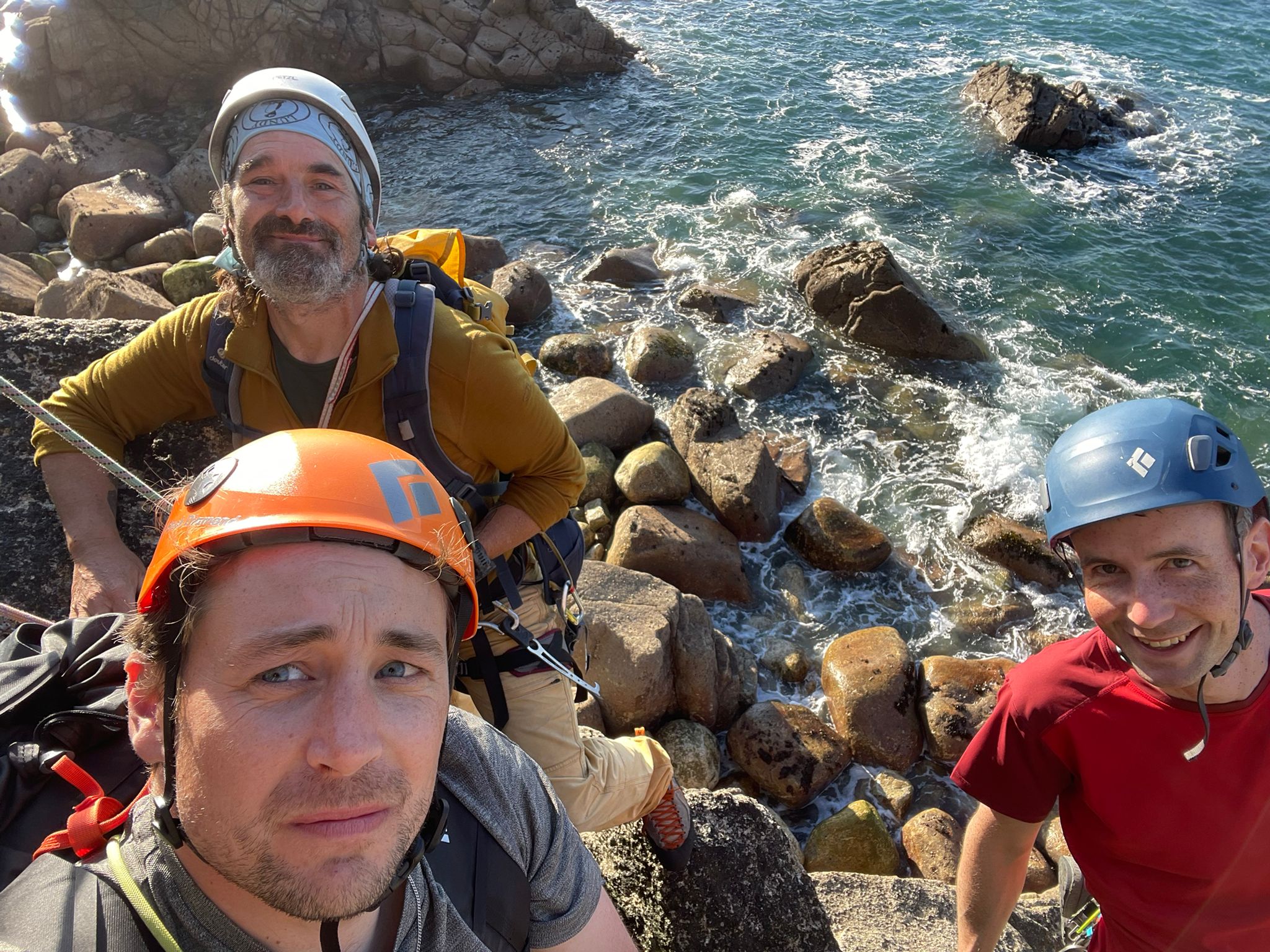
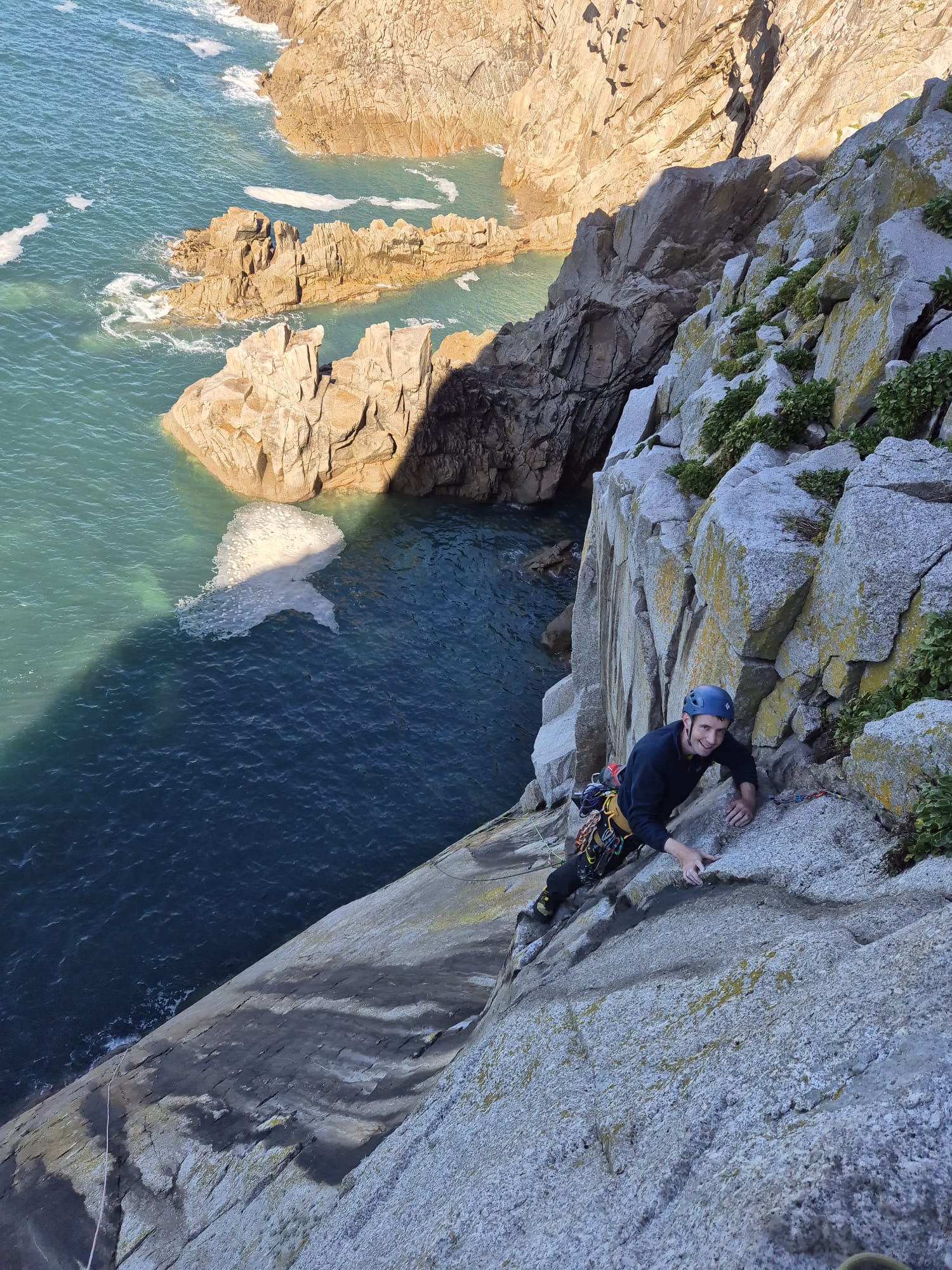
Friday 19 September – The Valley of Rocks
All of September, Lundy has been battered by strong westerly winds and rain. Hardly any of the classic routes have been logged on UKC given the best of the climbing is on the west-facing sea cliffs facing the Atlantic. But as the week approaches, the weather appears to be turning in our favour, with sunny spells and a more easterly bias to the wind. To avoid a horrendously early start, Peter and I have agreed to travel down to Ilfracombe on the Friday, stopping at the Valley of Rocks to get a couple of climbs in.
We arrive at the Valley in the early afternoon and seek out the Icarus Tower. This is set above the Exmoor sea cliffs (the largest in England), and the approach involves a steep scramble over Bracken with a perilous drop below. Peter takes the first lead, Icarus, a delightful hard severe with some exposed moves and great positions. After which, Peter abseils back down, and I haul the bags up to the top because we’ve both decided we don’t fancy scrambling back down the steep bracken with heavy bags on our backs. Joining Peter at the bottom, I then lead Lapyx, a HVS up an overgrown and somewhat loose corner with some steep pulls through a roof at the top. Finished for the day we head on to Ilfracombe.
Saturday 20 September – the journey over
Peter and I meet Neal at the harbour in Ilfracombe for the crossing over to Lundy on the MS Oldenburgh. It’s raining as we board the boat, which does its best to pitch and roll in otherwise calm seas, and it’s still raining as we arrive on Lundy. The Boat staff have stowed some of the climbing gear with the luggage such that we can’t access it immediately on arrival. But it doesn’t matter because the rain means there will be no climbing today.
We retreat to the Pub and await our luggage, which arrives mid-afternoon having been thoroughly soaked on the crossing (dry bags would have been useful). Peter and I largely get away with it, but Neal’s sleeping bag and clothes have to be tumble dried which the Island staff kindly do for him. We then snatch a lull in the worst of the weather to pitch our tents in the afternoon, before retiring to the pub for our evening meal. This is where we will choose to spend all our evenings over the week, and considering its monopoly position and captive audience, the pub offers good food at reasonable prices.
Sunday 21 September – the Flying Buttress
Sunday begins where Saturday left off and it’s still raining when we emerge from our tents. Peter and Neal opt for breakfast in the Pub, while I go for a walk to scout out the approach to the climbs we’ve planned, should the weather improve. From mid-morning, the last of the rain blows over, and a spell of sunny weather sets in that will last until we leave the following Saturday.
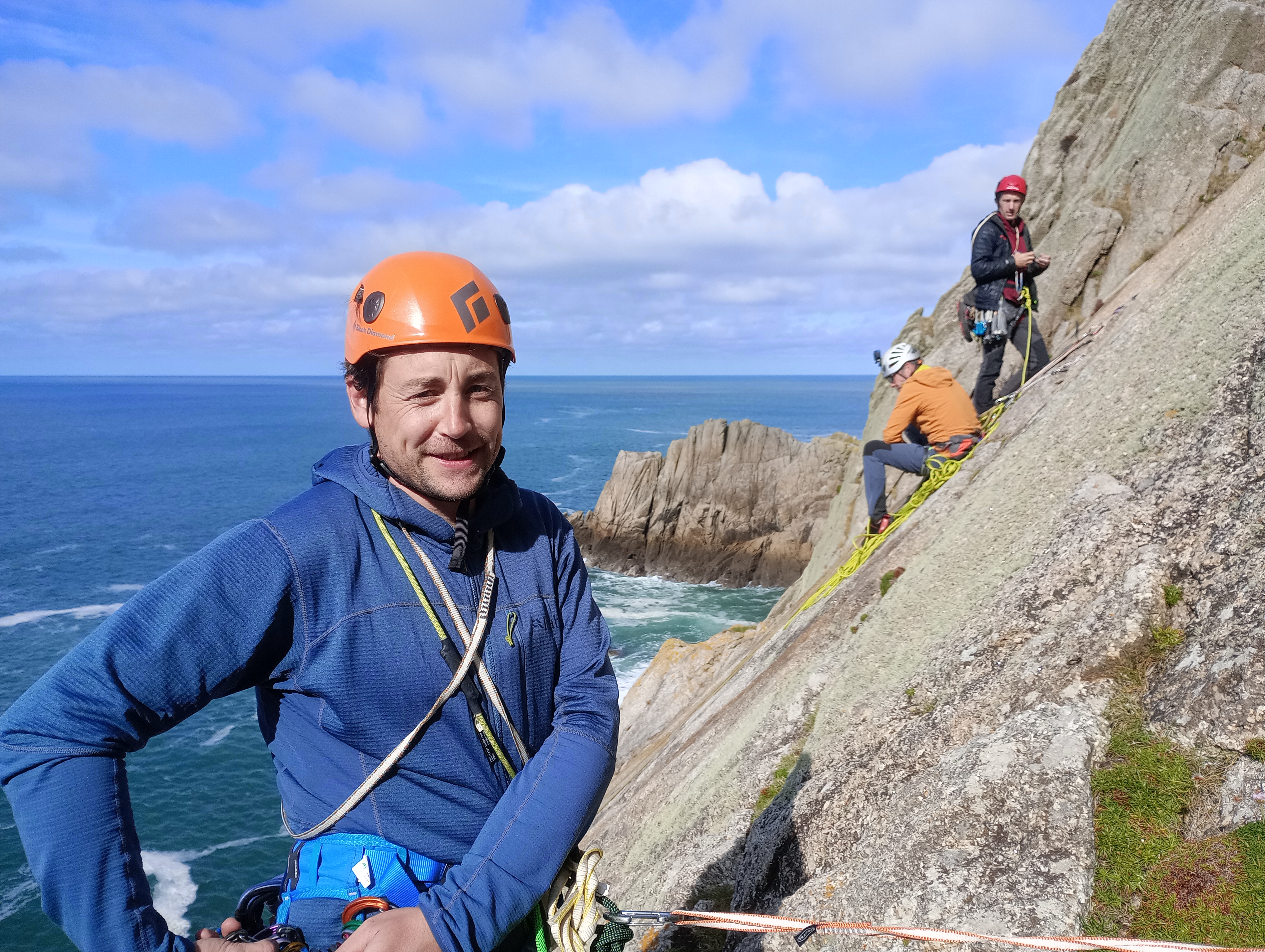
We head over to the Flying Buttress, one of Lundy’s most photogenic cliffs. We don’t fancy downclimbing the exposed mod, so the 100m static is unfurled for the first time and we abseil to the base of the Buttress. I get the trip started by leading Double Diamond, a three-star HVS, that pulls through a roof at the base of the Buttress before weaving up the centre of the slab above. It’s a great route, and I’m happy to despatch one of my top targets for the trip.
Peter follows this with a lead of Cappuccino, a nice VS on the same Buttress which follows a line of flakes, but not before the sea claims its first victim, dousing Neal’s foot on the approach. Neal completes the day by leading the second pitch of Horseman’s route, with the first pitch starting to look increasingly at risk of being wave washed. This is a fine route with an exposed traverse, and one which surely merits more stars than the single star the Climbers’ Club have awarded it.
Monday 22 September – American Beauty
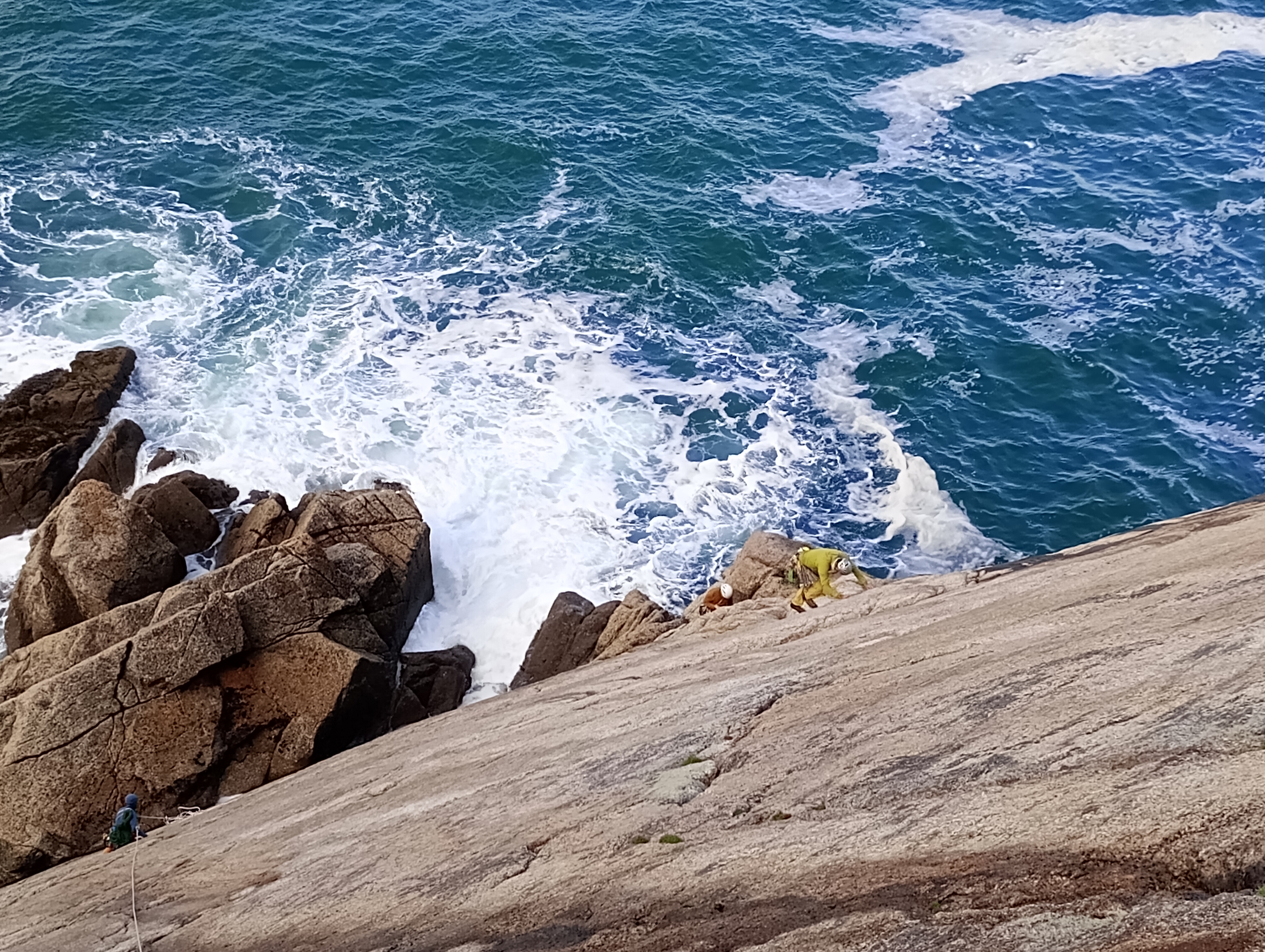
The day begins at 6.30 am with around 30 sheep breaching the wall into the campsite. For our second day of climbing, the three of us have agreed to do American Beauty, a three-star, three-pitch HVS in Grand Falls Zawn, and my top target for the trip. It’s harder to locate than the Flying Buttress, but we manage it and set up the abseil. This time it’s total commitment, a near 100 metre abseil down a steep and vegetated slab gaining a non-tidal ledge at the base of the cliff. From here, we are entertained by a seal which having woken up at the back of the nearby sea cave, makes hard work of hopping over boulders in the zawn to regain the sea.
Peter leads the first pitch in fine style, before I follow and join him at the stance. Neal then joins us at the belay, nearly pulling off a reasonably large hold as he does so. Deciding this will need to be trundled for the benefit of others, Neal removes the offending block which heads straight for the abseil rope stacked on the ledge at the base of the climb. To our collective relief, the block strikes the wall several meters above the rope and breaks off into several smaller pieces which sail either side of the rope in a scene reminiscent of the asteroid in Armageddon.
I then set off on the crux pitch, which involves 20 meters of climbing to reach an overlap on the slab. This will be followed by a traverse to the right under the overlap to reach its narrowest point. Some steep pulls surmount the overlap, before another traverse to the left above the overlap gains a stance at the base of a corner. The climbing to gain the overlap is thin and poorly protected, at one point requiring a long run out over technical slab moves. Reaching the overlap, I find it’s seeping badly, such that many of the holds on the first traverse are wet. Climbing in a three means I need to clip both ropes to every piece of gear on the traverse and by the end of the first traverse, I’m starting to run low on gear, Peter having retained some of my quickdraws for good luck. I pull through the roof and given the gear situation, have to start using the tapes on my cams and hexes to extend pieces on the second traverse. I arrive at the stance with just enough gear to build a belay having determined from below what it was likely to need.
Peter then follows, deciding to take a much harder line up the initial slab, before Neal joins us at the stance. Peter then leads the final pitch up the finishing corner, before a grassy top out regains the belay at the abseil point. Somewhat mentally exhausted, we choose to spend the afternoon at the more easily accessible Beaufort Buttress, climbing Force Eight, a two-pitch Severe, before retiring to the pub.
Tuesday 23 September – Landing Craft Bay
On Tuesday, we are due to be joined by James who’s arriving on the 8am boat from Bideford and so opt to climb local to the campsite at Landing Craft Bay. Shamrock, a three-pitch, three-star VS, is the first target. I run the first two pitches together, the first pitch consisting of a tough crack climb that can either be jammed or strenuously laybacked. In a departure from my usual approach, I opt for the former, with the second pitch a straightforward traverse across a slab. Peter then leads the final pitch which involves laybacking and bridging up a bulging corner.
We top out to be joined by James, who’s been enjoying the sunshine and discuss plans for the afternoon. We split off into two pairs, James and I going for the Indy 500, a three-star E1 crack climb, and Peter and Neal choose Cow Pie, a 2 pitch VS. The Indy 500 proves to be a sustained and pumpy crack climb, but with good holds and jams, and excellent gear. To my disappointment, I drop the final move, and with 40 meters of rope out take a reasonably large fall on rope stretch. Climbing back up, I notice the guidebook photographer has arrived to capture my second attempt, the added pressure ensuring the same result and I go for another big whip. The fun doesn’t end when I top out at the third attempt, as I discover there’s insufficient rope for me to reach a belay and return to the edge to watch James on the second. So, I untie, and after fixing the ropes to the belay, descend to the edge on clove hitches to watch James as he battles up on the second.
The excitement isn’t limited to the Indy 500. Although the climbing on Cow Pie is pleasant, Peter tops out into a steep mud slope into which are embedded large and loose blocks of granite, ready to rain down on climbers and belayers on the wall below. Unable to change into his approach shoes, Peter is forced to climb the extremely loose ground in his rock shoes which he manages somewhere between Type 4 fun and absolutely no fun at all, before bringing Neal up on the second. Later we discover from the comments on UKC, that their experience on Cow Pie is very much par for the course. But having selected the climb from the guidebook which gives no mention of the harrowing topout, there’s obviously no way they could have known this in advance.
Wednesday 24 September – The Devil’s slide
With the trip now having reached its full complement of climbers, we opt for the Devil’s slide on Wednesday so everyone can enjoy Lundy’s most recognisable climbs. A large party of climbers had arrived with James on the Tuesday, so we start early to ensure we’re the first to arrive on the slide. James and I pair up again, with Peter partnering with Neal, and over the course of the day, we each climb the Hard Severe that gives the cliff its name, and Albion, a VS that climbs the left-hand corner of the slide.
The Devil’s slide offers a relatively straightforward slab-climb over easy, but relatively bold ground, before a final exposed traverse to finish. Unfortunately for Neal, someone had helpfully jammed a nut into the only decent placement on this traverse. And even more helpfully, somebody else, perhaps disgruntled at there being fixed gear on a classic, had cut the wires on said nut such that it couldn’t be used for protection.
Albion starts similarly, before arriving at a main pitch which involves laybacking and bridging up the corner on juggy sidepulls and undercuts. Both climbs prove enjoyable classics, with more straightforward access and top outs than we’d found elsewhere on the island. We’re also joined on the slide by several other climbing teams, including James McHaffie, one of the UK’s foremost trad climbers, who’s on the island guiding clients.
Thursday 25 September – Stack Attack
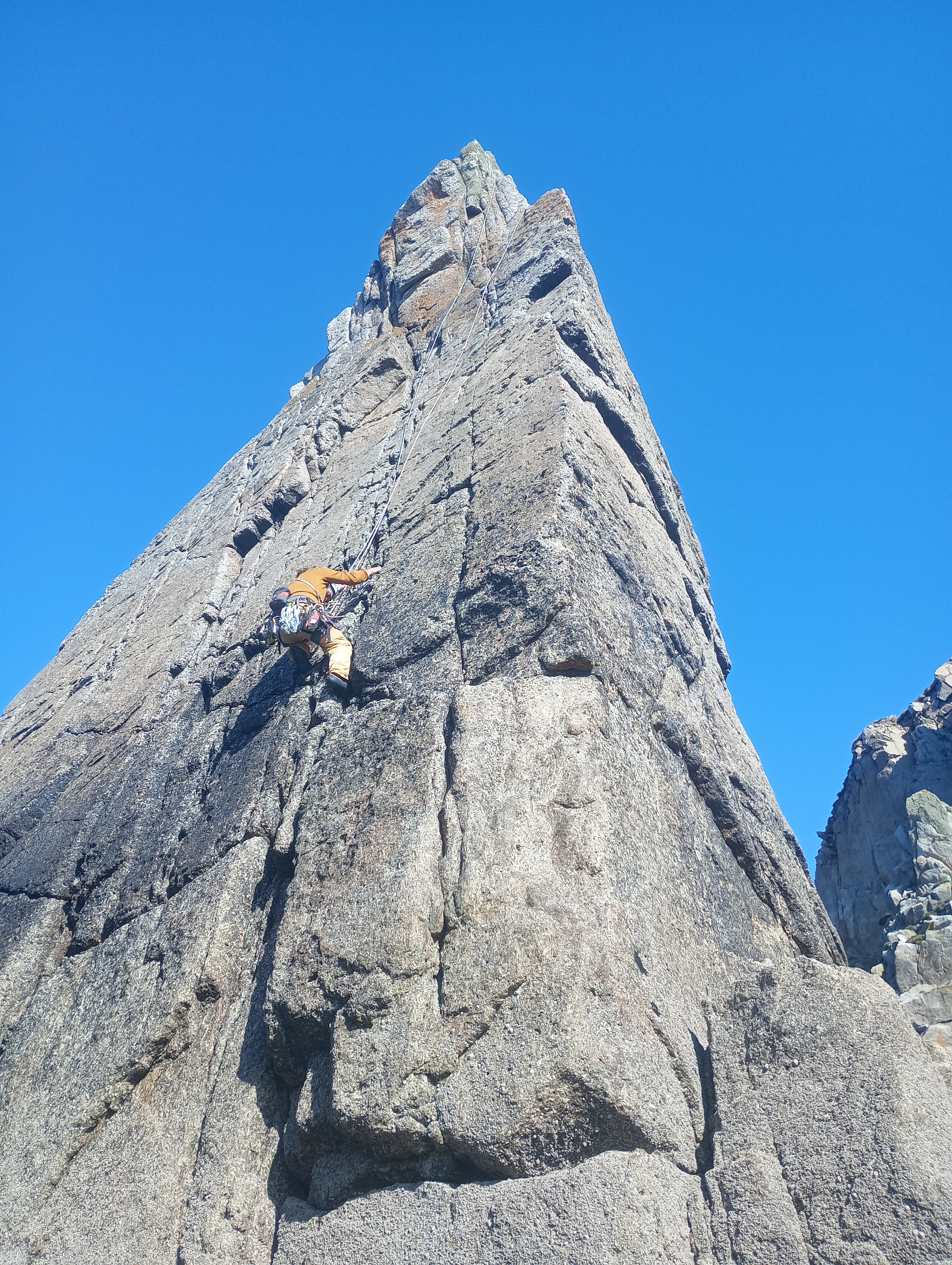
After a more sanguine day on Wednesday, it was time for something more adventurous on Thursday. The plan, dubbed “Stack Attack”, was to climb Lundy’s two most recognisable pinnacles, the Devil’s Chimney (England’s tallest sea stack) and Needle rock. This would involve abseiling in as the tide was falling, ascending and descending both pinnacles, traversing between them over a boulder field in the intertidal zone, and climbing back out before the tide came in.
Peter and Neal decide to concentrate their efforts on the routes on Needle Rock, so we agree that James and I will abseil into the base of the Devil’s Chimney, before Peter and Neal move the abseil line over to the Needle side of the cove. The abseil point for the chimney identified by the Guidebook is reached by a sketchy grass traverse over the edge of a cliff. Not fancying this, we decide to fix one of Peter’s lead ropes to a block higher up, attach the abseil rope to the end of the lead rope, and pass the knot above the edge of the cliff. The abseil itself involves a long descent over a broken spur with plenty of loose rock, although the solidity improves as we descend further.
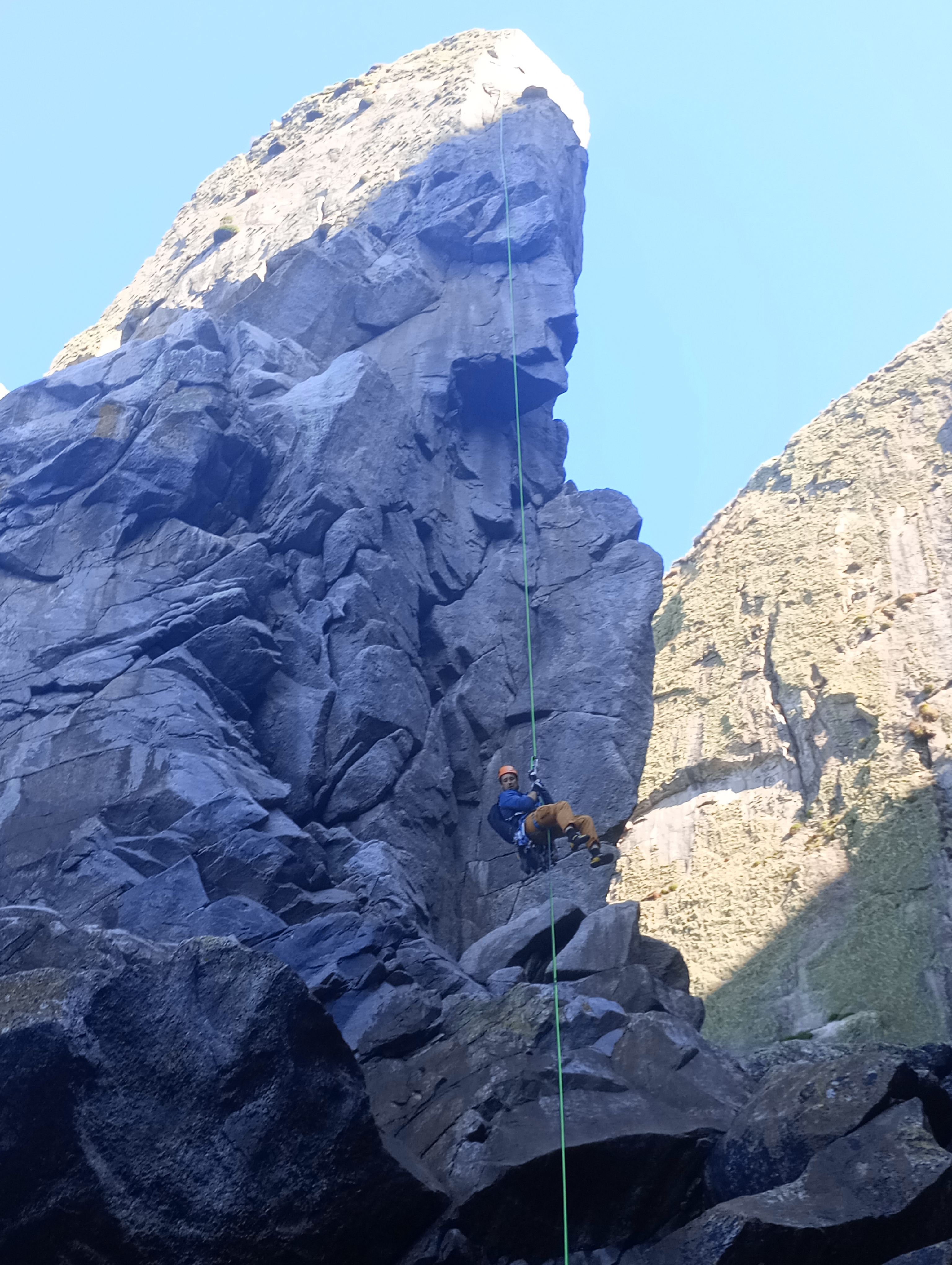
Both at the bottom, James and I get started on the Devil’s Chimney. There’s uncertainty over whether this three-pitch climb is VS or HVS, and the description of the start is vague. The route we take feels more like HVS than VS, and I run the first pitch into the second to save time. The second pitch tops out onto a ledge of loose blocks requiring some trundling to make the route safe for James to follow. James arrives at the belay, and we complete the technical and exposed final pitch to reach the pinnacle. Having read stories of ropes getting stuck, I set the abseil up over the overhanging face of the chimney. This ensures the descent is mostly free abseiling and the ropes pull easily at the bottom. We arrive back at the base of the chimney at exactly low tide, perfect timing for the long scramble over tidal boulders to reach Needle Rock.
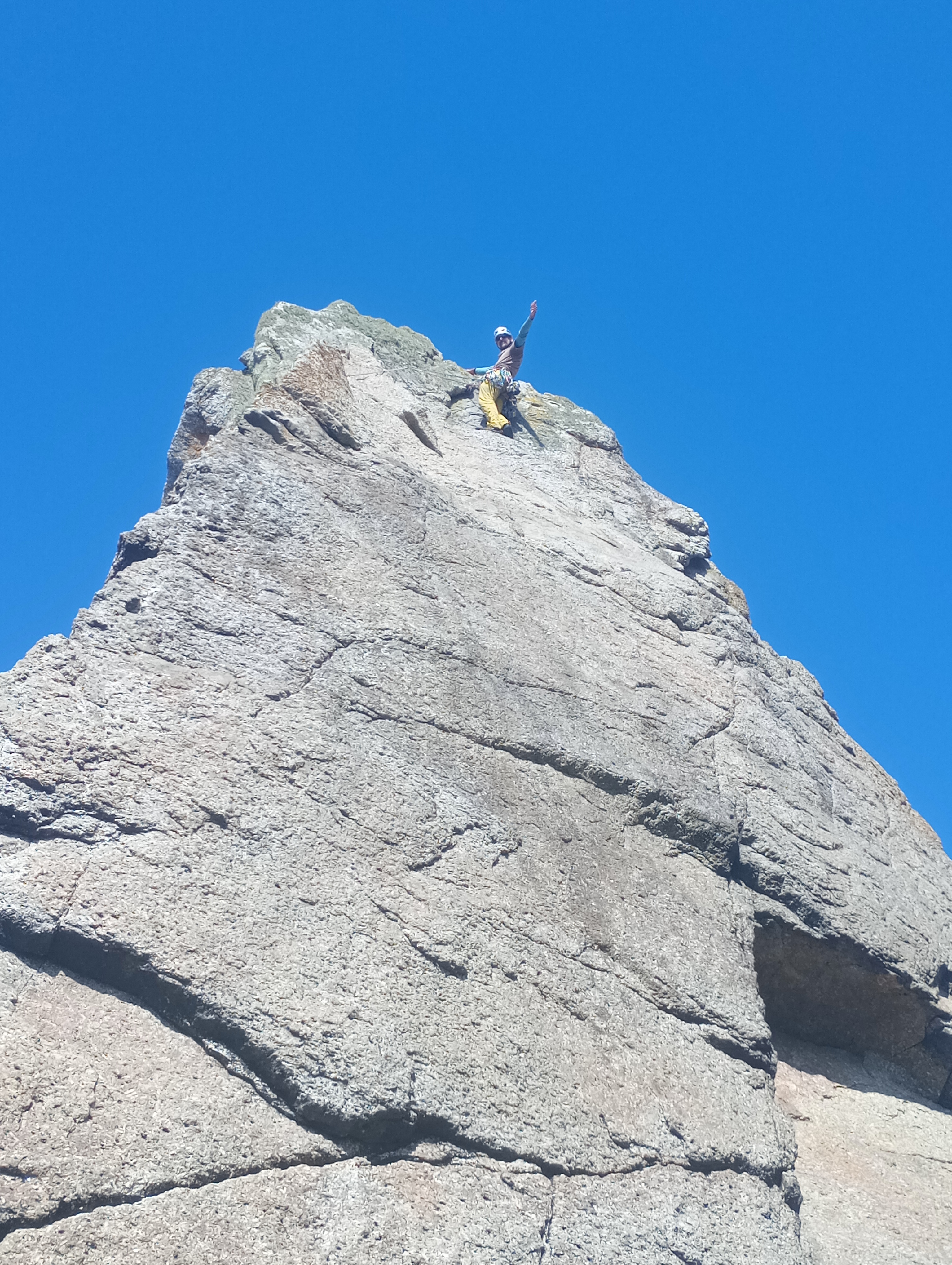
Arriving at the base of the Needle, we find Peter and Neal on Integrity, the three-star Hard Severe which climbs the southern face of the Needle before making an exposed rising traverse around the arete to gain the summit. Peter and Neal have already done Invincible, a VS which climbs the arete directly, and which Peter considers to be the better of the two routes. James and I also want to climb Integrity, so we have a quick lunch while waiting for Neal to get established on the second.
The routes on the Needle gave a great feeling of exposure as the Needle narrowed to a small flat point with the belayer hanging off the side. This provided more opportunity for learning about efficiency by setting up the abseil rope through the tat while belaying up the second.
Having finished at the Needle and with the tide now coming in, each party scrambles back along the boulder field to reach the base of the Punchbowl cliff and our VS escape route, Pretender. We climb this in two teams, Peter and Neal going first, which means Peter takes one for the team in navigating the grassy top out back along to the abseil rope for a belay. The belay position, on long spongey grass with a view out over the entire cove as the sun is setting, is the best of the week.
Stack Attack has been a great success, offering some proper adventure climbing, and has been a real team effort in terms of logistics and problem solving. The tides and the need to time things right to avoid being cut-off has also added something to the experience. On a personal note, ticking the Devil’s Chimney and Integrity also means that I’ve done everything I really wanted to do on Lundy with time to spare. Any climbing we do over the remaining day and a half will now truly be a bonus. For James, Stack Attack isn’t quite done, as he completes the day with a stacked burger in the Pub.
Friday 26 September – Immaculate slabs and Threequarter Buttress
On the final full day of climbing on the Island, we agree to split up for the first time. James and I will head over to Egyptian Slabs to do Immaculate Slab, and Peter and Neal will head over to Threequarter Buttress with Nonexpectis Jugsimisius the ultimate target.
Arriving at Egyptian Slabs, we locate the outcrop we’re supposed to abseil down from. Reaching the abseil point is straightforward but involves a steep grassy descent to within meters of the cliff edge. From here an intimidating abseil over steep ground reaches a ledge at the base of the slab. Arriving at the ledge, we find we have an audience of around 20 birdwatchers on a nearby boat, and we are soon joined again by James McHaffie and his clients, who have the same target in mind.
Setting off on Immaculate Slab, a three star, three-pitch HVS, I am met with thin moves on not particularly inspiring gear over a steep initial wall. Completing this, I am rewarded with an easier angled slab climb along an overhanging corner, made somewhat more intense by the water streaming out from below the overhang over all the holds. This rises to a steepening finish on jugs, before I top out somewhat relieved, having felt under more pressure than usual given the audience.
After breaking for lunch, James and I decide to make the long walk over to Seal Slab in the afternoon so James can do some leading and we can see the Northern part of the Island. This lives up to its hard-to-find reputation, and the tide is rising once we’ve found it and set up the abseil. Abseiling down, I’m met with spray from a wave and decide a high-tide start will be necessary. But not before I’ve had to free the abseil rope, the knot at the end of which has jammed itself below a boulder in the sea. Meeting me at the belay, James leads off on the Diff that gives the slab its name, a fun route up the middle of the slab. Finished for the day we venture up to the tip of the Island to take in the view.
Meanwhile, Peter and Neal have begun their day with the two Severes, Quadratus Lumborum a three-pitch climb which ascends to the right of an arete, before making a long traverse over the wall to the left of the arete, and then rising again to finish. This proving to be a bit of a sandbag, they then do Ligamentum Flavum, a direct on the former, which follows the arete more closely throughout.
These completed, Neal lowers Peter so he can downclimb Nonexpectis Jugsimisius, a two-star HVS with some airy and thin moves. Peter places gear as he goes, enabling him to then climb the line from the start with ropes and gear above him to avoid a large swing into clear space should he come off. Threequarter Buttress proves to be a great crag offering climbing on an undercut face far above the booming sea at the bottom of the zawn. Their climbing for the day completed, Neal and Peter then head off in search of the remains of a German Heinkel 111 bomber from WWII, which make for an obvious stop-off on the Lundy letterbox trail, and give their name to the nearby Bomber Buttress.
Saturday 27 September – Centaur and our return
Saturday is to be our final day on the Island, and we are up early to break camp and have our luggage packed before the 9am deadline. The boat will not be leaving until 4pm, so there’s an opportunity for more climbing, but all week the forecast has suggested the weather will turn on Saturday. In the event, while there are clouds around, the rain is not due to arrive until lunchtime. Peter and Neal opt for a more relaxed day, breakfasting in the Pub, taking in the view from the Old Lighthouse, and walking around the Island for a final time.
For James and I, the lure of one more climb proves too strong. We opt for Landing Craft Bay again because it’s close by and, with low tide now falling later as the trip nears its end, non-tidal. Abseiling in, our choice is vindicated because the sea is decidedly angrier today. We have chosen Centaur, a two-pitch HVS for our final climb and one which proves an absolute battle. It begins straightforwardly enough, the first pitch traversing rightwards over easy but exposed and slabby ground.
From here, the difficulty ramps up, starting with physical and thrutchy moves up a chimney. The roof at the top of the chimney is avoided by some awkward and exposed moves to gain a ledge. Before some more physical and steep pulls gain a groove above. This follows easier ground before the climb throws in its hardest move over blank terrain to gain the finishing flake. After abseiling back in and climbing out of the approach gully to retrieve a dropped cam, we make for the pub and a late lunch before joining Peter and Neal in the queue for the return boat.
On the journey home, we reminisce about the trip. Well three of us do, Neal is so knackered, he falls asleep on the table. We reflect on how lucky we’ve been with the weather, and how fantastic and adventurous the climbing has been. But also, how we all feel we’ve honed our wider climbing skills on the trip, to deal with sketchy and involved approaches, committing climbing, harrowing top-outs, and other unforeseen surprises. Lundy is a fantastic and unique climbing venue, a perfect destination for an adventurous trad trip. But to get the best from it, comfort at climbing multi-pitch VS and abseiling, knowledge of rope ascension and self-rescue skills, and some broader problem-solving experience feel like prerequisites. Use of walkie talkies undoubtedly makes communication a lot easier too. Our thoughts turn to the next adventure. The weather means we’ve largely got what we wanted from Lundy, so while no doubt we’ll return one day, perhaps the sea cliffs of the Scottish Isles should be our next target.


Great trip and some quality climbs. And some extensive abseil practise!